Case
Case

In high-risk industries such as oil, gas, chemicals, and energy, valves not only perform opening and closing functions but are also critical equipment for ensuring system safety, continuous operation, and compliance. Many procurement and technical personnel face a core question during the project selection phase: What are the differences between API valves and ordinary industrial valves? Is it necessary to choose valves that meet API standards?
This article will systematically analyze the key differences between API valves and ordinary industrial valves from the perspectives of technical standards, structural design, sealing, and testing requirements.
API valves are designed and manufactured strictly according to standards set by the American Petroleum Institute (API). Common standards include:
✅ API 6D: Line valves (gate valves, ball valves, plug valves)
✅ API 600 / API 602: Steel gate valves
✅ API 607 / API 6FA: Fire resistance test
✅ API 598: Pressure and sealing test
These standards are specifically designed for high-risk conditions such as oil and gas extraction, long-distance pipelines, and refining and petrochemical plants, emphasizing structural safety, failure control, and long-term reliability.
In contrast, general industrial valves mostly follow common industrial standards such as ISO, DIN, GB, and BS, primarily targeting water systems, HVAC, and low-pressure industrial fluids, with design goals leaning more towards versatility and economy.
The core difference lies in this:
API valves are designed with "controllable accidents and minimized risks" as the premise, while general industrial valves are more focused on "usability under normal operating conditions."
API valves incorporate higher safety redundancy during the design phase:
For example, API 6D pipeline valves must maintain structural integrity under high pressure fluctuations, rapid opening and closing, and emergency shutdown conditions, which is not a mandatory requirement for ordinary industrial valves.
WEIZIDOM API Valve Advantages:
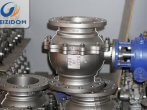
WEIZIDOM's API 6D gate valves and ball valves are widely used in oil and gas gathering and distribution pipelines and distribution stations. The valve bodies are made of high-strength carbon steel or alloy steel, meeting high-pressure levels and long-term operational requirements.
API valves have clear and quantifiable requirements for sealing performance:
1. They mostly employ metal seals or composite seal structures.
2. Leakage rates are strictly controlled (compliant with API 598).
3. They must pass the API 607 / API 6FA fire resistance test.
Ordinary industrial valves are mostly soft-seal designs, suitable for clean media, but the risk of seal failure is significantly higher in high-temperature, high-pressure, and flammable media.
WEIZIDOM API ball valves and gate valves can choose metal hard-seal structures and have passed fire resistance design verification, suitable for natural gas, crude oil, and high-temperature oil applications.
API valves must pass a series of mandatory tests, including:
🎯 Shell strength test
🎯 High and low pressure sealing test
🎯 Fire resistance test
🎯 Operating life and durability test
And usually require third-party witnessing and a complete test report.
Ordinary industrial valves mostly undergo basic factory testing and are not required to undergo fire resistance or life testing.
WEIZIDOM API valves undergo rigorous testing procedures according to API standards, ensuring that each valve has complete and traceable quality documentation before delivery, meeting international oil and gas project audit requirements.
📌 API valves are suitable for:
Oil and gas extraction, processing, and transportation
Long-distance pipelines, stations, and terminal facilities
Refining, petrochemical, and high-pressure chemical plants
High-temperature, high-pressure, flammable, explosive, and toxic media
📌 General industrial valves are suitable for:
Municipal water supply and drainage
HVAC systems
General industrial water treatment
Low-pressure, non-hazardous media conditions
WEIZIDOM's positioning: Focusing on valves for oil and gas, energy, and engineering projects, providing API 6D gate valves, ball valves, and matching actuators, serving applications with extremely high safety and compliance requirements.
When projects involve oil and gas media, high pressure, high safety risks, or mandatory regulatory requirements, choosing API valves is not an "upgrade," but a necessary condition. In low-risk, low-pressure general industrial applications, ordinary industrial valves are sufficient and offer a better cost advantage. The correct approach is not to "choose the highest standard," but rather to "choose the most suitable standard."
With a product system compliant with API standards, rigorous quality control, and mature engineering experience, WEIZIDOM API valves provide reliable, verifiable, and long-term operational valve solutions for oil and gas projects.
More products: API valves, API 6D valves, oil and gas valves, API gate valves, API ball valves, WEIZIDOM API valve, oil and gas valve manufacturer, pipeline valve