Case
Home / Case / Experience / Are you still using knife gate valves incorrectly?

Case

If your plant handles thick slurries, abrasive powders, fibrous wastewater, or particulate-laden media, you already know the problem: conventional gate valves jam, ball valves clog, and globe valves wear out far too quickly. There is a better solution — the Knife Gate Valve.
Unlike wedge gate valves that rely on a solid wedge, the knife gate valve features a sharp, beveled gate (blade) that cuts through thick media, rag, and compacted powder. It has no body cavity where solids can accumulate. It provides a full bore, unobstructed flow path when open. And it shuts off bubble-tight against the toughest media — even with solids trapped in the closing path.
* What a knife gate valve is and how it works
* Why it outperforms other valve types in slurry, powder, and wastewater service
* Key applications across mining, coal washing, wastewater treatment, and food processing
* How to select the right materials (WCB, 304/316 stainless steel, UHMWPE seats)
* Pneumatic actuation options for automated plants
If you are responsible for plant reliability, maintenance costs, or process uptime, this guide is for you.

A knife gate valve is a linear motion isolation valve designed specifically for slurries, particulate matter, powders, and viscous fluids. Its defining feature is a sharp, beveled gate (the “knife”) that cuts through thick media to achieve a positive seal — even when solids are present in the closing path.
The gate moves vertically through a packing gland that seals around the gate.
Open position: The gate is fully retracted into the bonnet, leaving a smooth, full bore flow path — no obstructions, no pressure drop.
Closed position: The knife edge cuts through media, seats against a replaceable seat (UHMWPE, stainless steel, or elastomer), and provides bubble-tight shut-off.
No body cavity — solids cannot accumulate and prevent full closure.
This self-clearing design is the key reason knife gate valves succeed where other valves fail.
| Feature | Benefit |
| Knife-edge gate | Cuts through rag, fibers, thick slurries, and compacted powder |
| Unobstructed full bore | No settling, no plugging, minimal pressure drop |
| No body cavity | Self-clearing — no solids accumulation |
| Replaceable seat | Extended service life; seats replaced without removing valve |
| Pneumatic or manual operation | Fast, remote, or local control |
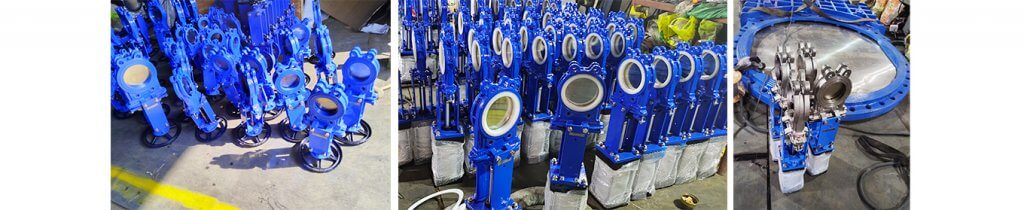
At WEIZIDOM, our knife gate valves are manufactured to JB/T8691-1998 with strict quality control (12 tests), in WCB carbon steel and 304/316/316L stainless steel, with manual handwheel, pneumatic actuator, or electric actuator options.
Knife gate valves are deployed wherever thick, solids-laden, or fibrous media must be reliably isolated. Below is how they perform in key plant environments.
| Function | Specific Role |
| Ore slurry isolation | Mill discharge, cyclone feed, concentrate transfer |
| Tailings lines | Thickened tailings, disposal line isolation |
| Sand & gravel handling | Desanding lines, slurry pumps |
Why knife gate? Cuts through abrasive particles; full bore prevents settling; self-clearing design resists clogging.
| Function | Specific Role |
| Coal slurry feed | Dense medium circuits, cyclone feed |
| Refuse lines | Reject handling, magnetite slurry |
| Clean coal transfer | Product lines |
Why knife gate? Handles high solids content; sharp gate cuts through coal particles; UHMWPE seat resists abrasion.
| Function | Specific Role |
| Primary/secondary sludge | RAS/WAS lines, digester feed |
| Grit slurry | Grit classifier discharge |
| Scum lines | Floatables isolation |
Why knife gate? Cuts through rag, stringy material, and debris; no body cavity means no rag build-up.
| Function | Specific Role |
| Fruit pulp | Fruit processing lines |
| Vegetable slurries | Puree and slurry transfer |
| Viscous sauces | Dense product isolation |
Why knife gate? 304/316 stainless steel construction; smooth, full bore flow path; easy cleanability.
| Function | Specific Role |
| Fly ash lines | Pneumatic conveying isolation |
| Bottom ash handling | Ash sluice lines |
Why knife gate? Handles dry, abrasive ash; sharp gate cuts through compacted ash; metal seat for high temperature.
| Function | Specific Role |
| Wood pulp stock | Stock lines, consistency control |
| Black/white liquor | Chemical recovery lines |
Why knife gate? Cuts through fibrous pulp; corrosion-resistant stainless steel; no fiber bridging.

We’ve distilled the knife gate valve’s strengths into six compelling advantages that plant engineers value most.
| Advantage | Why It Matters |
| Sharp knife-edge gate design | Cuts through thick slurries, rag, and compacted powder — will not jam like conventional gates. |
| Unobstructed, full bore flow path | No body cavity — no solids accumulation, no plugging, no settling. Self-clearing. |
| Pneumatic actuation – fast, remote, failsafe | 1–5 second cycle time; spring-return options for ESD; remote operation from control room. |
| Replaceable seat (UHMWPE / SS / elastomer) | Extends valve life; seat replaced without removing valve from pipeline. |
| WCB or 304/316 stainless steel construction | WCB for general service; stainless steel for corrosive, sanitary, or food applications. |
| JB/T8691-1998 compliant | Manufactured to recognized knife gate valve standard — ensures design integrity and performance. |
| Material | Best For | Key Characteristics |
| WCB | Mining, coal washing, general slurry | High strength, cost-effective, durable |
| 304 Stainless Steel | Food processing, mild corrosive | Good corrosion resistance, sanitary |
| 316 / 316L Stainless Steel | Chemical, pharmaceutical, wastewater | Excellent corrosion resistance, chloride resistance |
| Seat Material | Best For | Temperature | Shut-Off |
| UHMWPE | Mining slurries, coal slurry, abrasive media | -40°C to +80°C | Bubble-tight |
| Stainless Steel | High temperature, abrasive, steam | -50°C to +400°C | Moderate (metal-to-metal) |
| EPDM | Water, wastewater, mild chemicals | -40°C to +120°C | Bubble-tight |
| PTFE | Chemicals, corrosive media | -20°C to +200°C | Bubble-tight |
| Actuator Type | Fail-Safe | Best For |
| Manual handwheel | N/A | Local control, non-critical |
| Pneumatic double-acting | Hold last position | High-cycle, automated plants |
| Pneumatic spring-return | Closed or open on air loss | ESD, safety-critical |
| Feature | Knife Gate Valve | Wedge Gate Valve | Ball Valve |
| Solids handling | Excellent (cuts through) | Poor (jams) | Poor (cavity traps solids) |
| Body cavity | None | Yes (collects solids) | Yes (cavity) |
| Full bore | Yes | Yes | Optional |
| Rag/fiber handling | Excellent | Poor | Poor |
| Slurry service | Excellent | Poor | Moderate |
| Price (DN100+) | Low-moderate | Moderate | High |
Conclusion: For slurry, powder, and wastewater service, the knife gate valve is often the most reliable and cost-effective choice.
We are not just a valve manufacturer — we are an industrial pipeline solution provider with five domestic factories and exports to 108+ countries.
| Reason | Benefit |
| JB/T8691-1998 compliant | Recognized national standard — quality assured |
| DN50–DN700 | From branch lines to main slurry lines |
| PN10/PN16/Class150/10K | Standard pressure ratings |
| WCB / 304 / 316 / 316L | Material options for any media |
| UHMWPE / SS / EPDM / PTFE seats | Replaceable — extended service life |
| Pneumatic actuation | Double-acting or spring-return; solenoid valve, limit switches, positioner |
| Guideline | Why |
| Verify flow direction (arrow on body) | Most knife gate valves are uni-directional. |
| Install with gate vertical (preferred) | Ensures proper packing performance and gate guidance. |
| For settling slurries, install with flow upward | Prevents solids from settling on closed gate. |
| Provide clean, dry compressed air for actuators | Contaminated air damages actuator seals and solenoid valves. |
| For dry powder, add purge ports | Prevents powder packing in packing chamber. |
| Install isolation valves upstream/downstream | Allows valve removal without draining the line. |
| Parameter | Specification |
| Standard | JB/T8691-1998 |
| Diameter | DN50 – DN700 |
| Pressure | PN10, PN16, Class150, 10K |
| Body materials | WCB, 304, 316, 316L |
| Seat materials | UHMWPE, SS, EPDM, PTFE |
| Actuation | Manual, pneumatic DA, pneumatic SR |
| Accessories | Solenoid valve, limit switches, positioner, FRL |
| Media | Slurry, powder, sludge, pulp, ash |
Contact WEIZIDOM today for a free consultation and no-obligation quote. Tell us your media, line size, pressure, and actuation requirement — we will recommend the optimal knife gate valve for your end-user plant.